Why Your Dirt Driveway Keeps Washing Out (and How to Fix It for Good)
Home › Blog › Why Your Dirt Driveway Keeps Washing Out (and How to Fix It for Good)
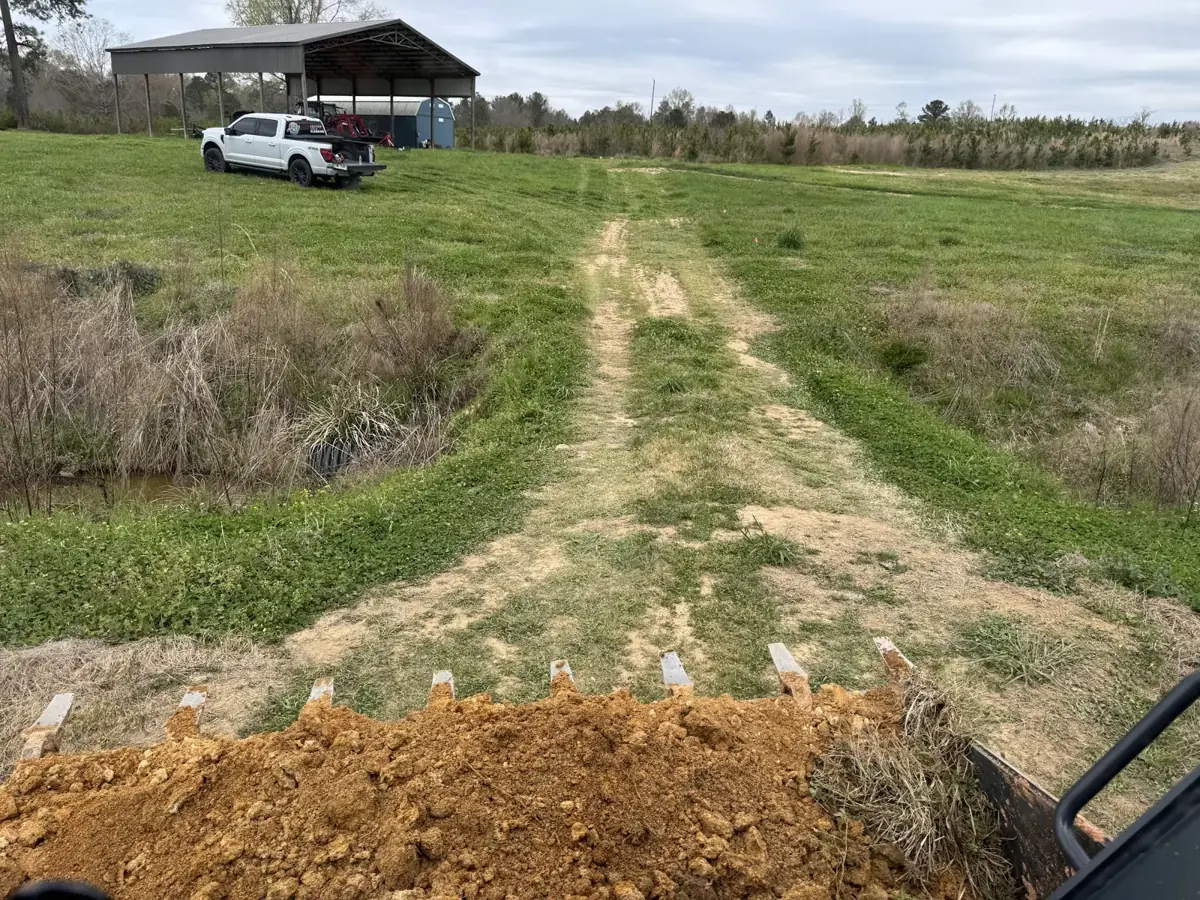
If you keep adding gravel and the ruts keep coming back, the problem is usually water, not gravel. Here’s what a lasting fix looks like.
A familiar problem out here
In a lot of Middle Georgia, especially out in the county, the last stretch home is a dirt or gravel driveway. Some are a few hundred feet long, some run a quarter mile or more through pasture and woods. They work fine when they’re in good shape. But after a few heavy rains, plenty of them turn into a mess of ruts, potholes, washboard bumps and soft spots that make you slow down to a crawl.
If you’ve ever had a load of gravel dumped on your driveway only to watch it wash out again a few months later, you’re not alone. The good news is that most driveway problems come down to one thing, and it can be fixed.
Water is the real problem
Almost every dirt or gravel driveway problem is a water problem. When a driveway is flat, or worse, when it sits lower than the ground on either side, rain has nowhere to go but straight down the middle. Moving water picks up loose gravel and fine dirt and carries it downhill. Every storm cuts the ruts a little deeper.
Traffic makes it worse. Tires push into wet, soft spots and turn them into potholes. Over time, the gravel gets pushed into the dirt or off to the sides, and the drive loses its shape completely.
Why more gravel isn’t enough
The first fix most people try is a load of gravel. It fills the holes and smooths things out, and for a little while the driveway looks great. But if the drive is still shaped wrong, the water keeps running down the middle and the new gravel goes the same way as the old gravel.
Gravel is the top layer of a driveway, not the fix for it. Without a base shaped to move water off to the sides, you end up buying gravel over and over.
What a lasting repair looks like
A lasting driveway repair starts with the shape. The high spots get cut down and the ruts and holes get filled. The surface is then graded with a slight crown or slope, so rain runs off to the edges instead of down the middle. Where water collects along the edges, it needs somewhere to go.
Only once the base is right does fresh gravel go down. Spread and worked into a properly shaped drive, it stays where it belongs a lot longer, and the drive dries out faster after rain.
Small things that help
A few simple habits make any repair last longer. Fix small ruts and potholes early, before the next storm deepens them. Keep brush and limbs cut back along the sides so the drive gets sun and air and dries out faster. Avoid driving heavy loads on the drive while it’s saturated if you can. And keep an eye on spots where water crosses or pools, because that’s where trouble starts.
On wooded drives, clearing back overgrown edges at the same time as a repair is often worth it. It makes the drive wider, brighter and easier to keep up.
Getting your driveway fixed
We repair dirt and gravel driveways around Knoxville and across Crawford, Peach, Houston, Bibb, Monroe and Taylor counties. We’ll walk your drive with you, show you where the water is doing the damage, and give you a price for the whole repair. Read more about our driveway repair service or give us a call.
Ready to get your land back?
Tell us about your property and what you want it to be. We’ll come take a look.
Get an Estimate